
SkyScroll delivers controllable and targeted geoengineering, with minimal side-effects.
Overview #
An airborne sunshade is:
- a solar reflector floating in the atmosphere, used to cool the Earth
- much easier and quicker to develop and deploy than a space sunshade
- easily targeted to where it can have the greatest beneficial impact, such as the Arctic
- a relatively low-risk approach with no moral hazard
Airborne Sunshade #
- Reflecting a proportion of the sun’s energy away from the Earth is the most straightforward approach to cooling the Earth.
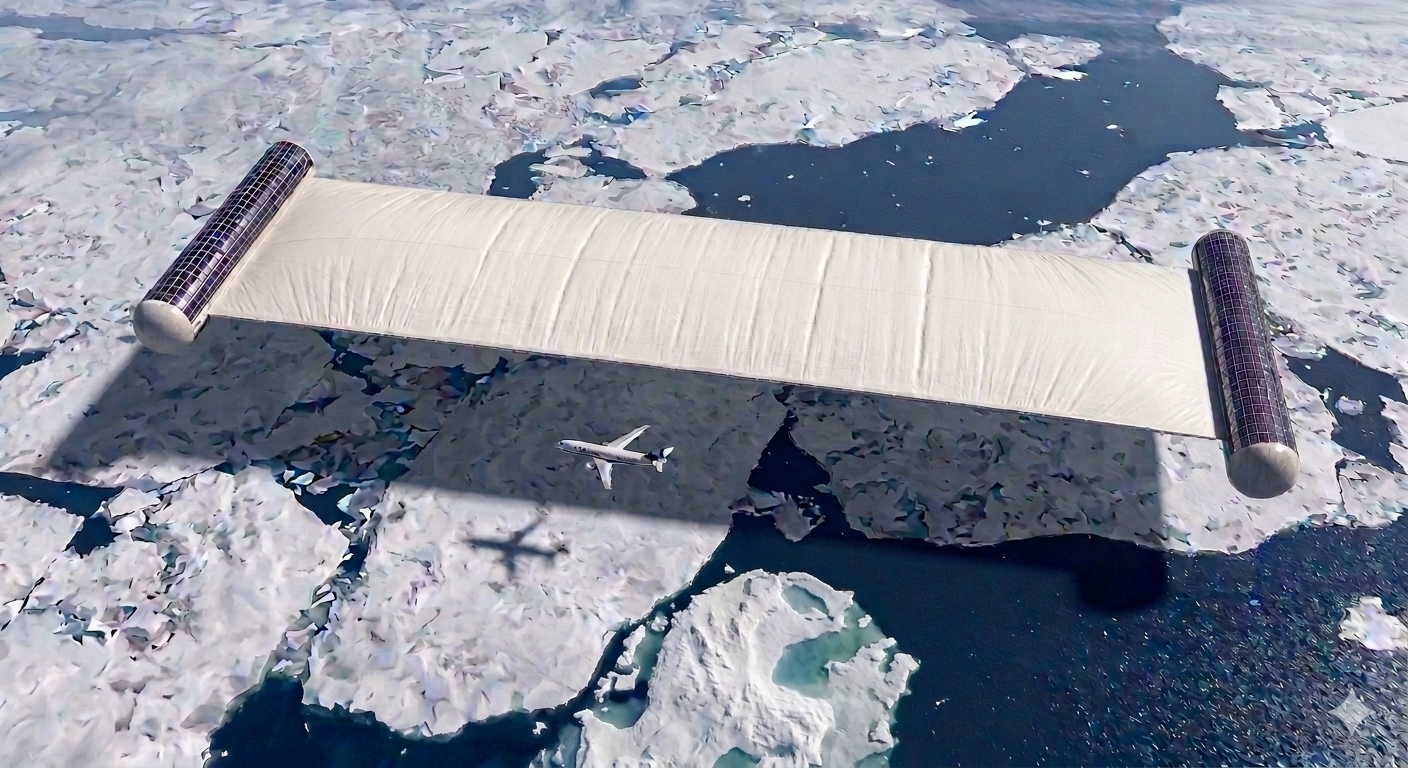
- The airborne sunshade is a airborne system with a high albedo or reflective coating, which flies in the stratosphere, and casts shade on a part of the Earth’s surface.
- It is analogous to a space sunshade or planetary sunshade, but would be much easier and quicker to develop and deploy - see below.
- Using airborne reflector for this purpose was first proposed by Prof Narayanan Komerath in 2017.
- SkyScroll’s airborne sunshade is based same basic principle, but with a completely new lighter-than-air platform, invented by Dr Martin Morrey in 2020.
- SkyScroll can deploy a huge surface area of targeted shade, to a highly specific target, such as open sea in the Arctic region.
Comparison With Space Sunshade #
One approach that has been mooted for a while, is placing mirrors or diffractors directly between the sun and the Earth; i.e. a “space sunshade” or “Planetary Sunshade”.
A space sunshade would help cool the Earth, but it would be extremely challenging, costly and time-consuming to build.
For example, the Planetary Sunshade Foundation FAQ says cooling the Earth by 1°C would require launching a mass “at least 100,000 times as much as the ISS”.
We believe an airborne sunshade would be quicker, cheaper & more targeted then a space sunshade.
The following table summarises how the space and airborne sunshades compare:
| Space Sunshade | Airborne Sunshade | |
|---|---|---|
| Position | L1 Lagrange point | Lower stratosphere |
| Altitude | 1,500,000 km | 10 km - 20 km |
| Cost | $ trillions | $ billions |
| Coverage | global | targeted |
| Impact | constant | controllable |
| Current Tech? | No | Yes |
| Timescale | ~30+ years | ~10 years |
Targeted & Safe #
- We believe SkyScroll could have a significant role to play as an interim solution for the most urgent climate problems, such as in the Arctic.
- SkyScroll was designed both as alternative or a complement to the most well-known approaches to global geoengineering, i.e. Stratospheric Aerosol Injection (SAI).
- SAI is potentially a relatively cost-effective solution to cooling the Earth as a whole, but it has many challenges and has been dogged by controversy.
- One key problem is that it is very difficult to target the effects of SAI.
- Model experiments indicate doing stratospheric aerosol injection at the poles may help localise impacts, but there is always a global impact.
- SkyScroll is a completely targetable geoengineering tool, with no obvious negative side effects.
- SkyScroll was specifically designed to play a major role in the urgent and radical goal of refreezing the Arctic.
A Moral Hazard? #
- Many argue geoengineering is dangerous path to go down, and a “moral hazard”, because it could be used to disincentive reductions in greenhouse gas emissions.
- These are rational concerns, and no geoengineering proposal should ever be used to justify avoiding cutting greenhouse gas emissions urgently and deeply.
- However, in weighing up the pros and cons, it is also necessary to consider the the “moral hazard of non-research”.
- Evidence indicates there are some critical parts of the climate emergency which cannot now be addressed by emissions reductions alone, in particular the situation in the Arctic.
- Therefore, there is no inherent moral hazard in solutions specifically targetting the Arctic.