
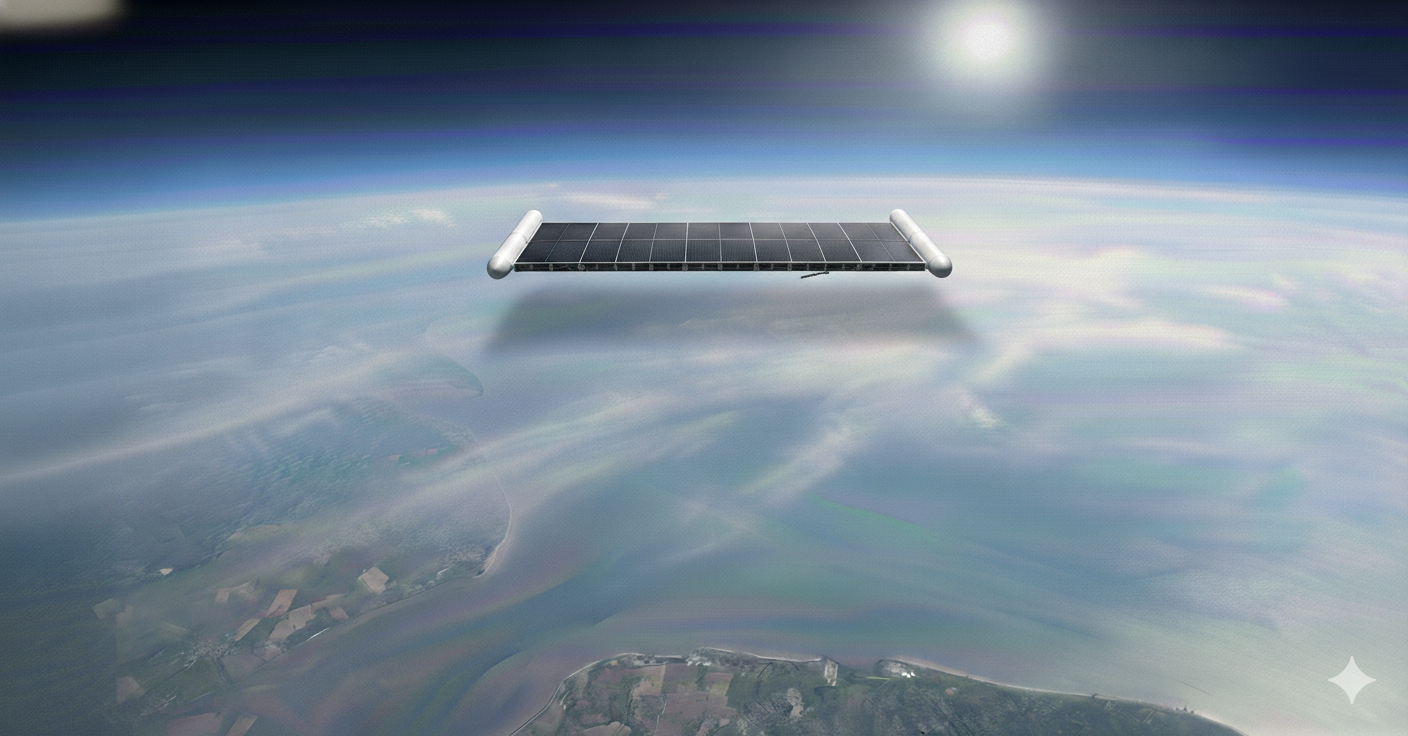
SkyScroll has a large surface area at high altitude, which is perfect for providing power to stratospheric payloads
HAPS Background #
High Altitude Pseudo Satellites (HAPS) are airborne platforms for providing communications or Earth-observations from the stratosphere. They operate in a relatively stable part of the atmosphere, well above normal air traffic.
For communications applications, HAPS offer several potential benefits over satellite, including 5G-smartphone compatibility, lower latency, higher bandwidth, lower costs, and being more environmentally friendly.
Power Limitations #
However, most current proposals for communications HAPS are significantly power constrained. According to a recent funding solicitation from ARIA “300W is significantly beyond capability of state-of-the-art platforms”.
SkyScroll has the potential to offer 10x to 100x the power availability, with 3kW or 30kW potentially available to a telecoms payload.
The SkyScroll Difference #
Most LTA craft can only carry a small payload into the stratosphere, where atmospheric pressure is ~10 times lower. To allow for gas expansion, normal LTA craft can only be ~10% full of lifting gas at take off.
SkyScroll’s compound LTA platforms are different. They marry one or more conventional airships with a purpose-specific component, the “raft”, which serves three key purposes:
- Provide gas expansion volume, enabling the airships to 100% full of lifting gas on take off
- Act as a payload at take off, but become neutrally buoyant at the target altitude
- Provide a flat base of very large surface area, to maximise interaction with sunlight
A SkyScroll-Based HAPS #
Typically a SkyScroll-based HAPS would consist of an inflatable raft joined to two communications-capable stratospheric airships.
The raft would:
- share lifting gas with the airships, and provide power to them.
- be covered with thin-film solar cells to generate power
- incorporate interleaved battery cells to store a portion of the electrical energy generated, for use in the hours of darkness.
When covered with thin-film PV cells, the raft can provide power equivalent to a large ground-based solar power station.
Estimated Power Availability (Worst Case) #
The following table summarises estimations of the scale and electrical power of a SkyRaft-based system, flying at 18km altitude at latitude of 50°N, for a range of airship dimensions
| Airship Length | Airship Diameter | Maximum Surface Area of Raft (m2) | Maximum Width of Raft (m) | Mean Power in 8hrs Daylight Dec 21st (kW) | Mean Power in 16hrs Darkness Dec 21st (kW) |
|---|---|---|---|---|---|
| 75 | 18 | 25,000 | 500 | 600 | 200 |
| 100 | 24 | 60,000 | 900 | 1,500 | 500 |
| 125 | 29 | 125,000 | 1,400 | 3,000 | 1000 |
| 150 | 35 | 215,000 | 2,000 | 5,000 | 1,600 |
The above results are based on the following assumptions and parameters:
- Solar input on 21st December, the shortest and darkest day of the year in the Northern Hemisphere
- “Raft” of areal density of 1kg m-2 , including
- Gas envelope with strength reinforcement, covered with thin-film solar cells
- Interlaced lithium-metal, lithium-sulphur, or lithium solid-state pouch cells, storing up to 500Wh kg-1
- Lightweight wiring looms and control circuitry
- Expected depth of horizontal raft at 18km of ~18m
- Incorporating sufficient battery cells to store ⅔ of the 8-hours of daylight power, to cover 16 hours of darkness
- Airship dimensions scaled from the 140m “Stratobus” semi-rigid HAPS airship